calculator
header
solar water heaters solar water heater technical solar water heater Design Solar Water Heaters Systems solar water heater Pricing solar water heater Q&A solar water heater Images solar water heaters about
Solar Water Tanks Solar Insulated Piping Solar Heat Exchanger Solar Controller Solar Evacuated Tube complete solar heating packages

Solar Heat Exchanger


solar heat exchangers

solar pool heat exchanger

 Solar Plate Heat Exchangers

Solar Pool Heat Exchangers


A Solar Heat Exchanger is an effective way to transfer heat between two different liquids.  The liquids can have different physical properties such as water and glycol or they may need to be separated because of different operating pressures.  Whatever the reason our solar heat exchangers allow the transfer of energy, efficiently, with virtually no heat loss. 

There are two types of Solar Heat Exchangers


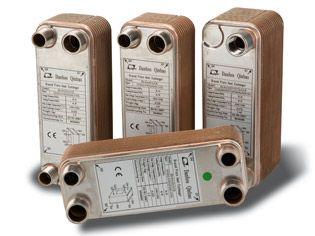
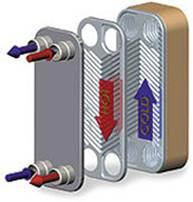
Brazed Plate Heat Exchanger - Used for Solar Home Heating applications such as Solar Radiant Floor Heating and Solar Snow Melting

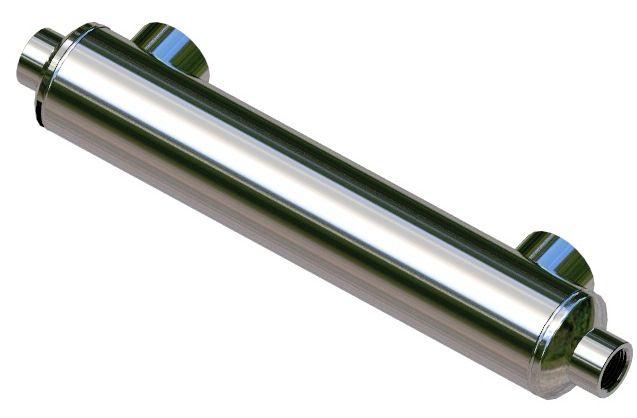
Tube in Shell Heat Exchangers - Used for Solar Pool and Hot Tub Heating applications.


Three variables are important in transferring energy when using a solar heat exchanger

      1. Area of heat transfer surface separating the two liquids
      2. Flow rate of the two heat transfer fluids.
      3. Pressure drop across both sides of the heat exchanger


Increasing the surface area will decrease the temperature difference between the two sides  needed to drive the heat transfer or the greater the power the heat exchanger can handle for a fixed differential temperature.  Increasing the flow so that it is more turbulent  improoves the heat transfer, but mostly it determines the differential temperature from in to the out ports. The less restrictive the heat exchanger is toflow (the lower the pressure drop) the lower the wasted energy required to pump the luids through the heat exchanger.  Brazed plate solar heat exchangers have approximately the same pressure drop on each side, and provide for a large heat transfer area given the volume of the heat exchanger.  the pool type solar heat exchanger is designed to handle high flow and produce a small pressure drop on the pool side of heat exchanger.

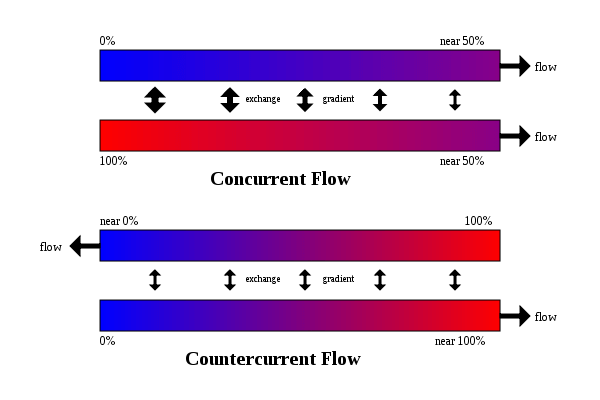
The physical direction of  the flow in the heat exchanger is recommended to be in opposite directions.  This is known as Counter Current Flow.  Hot and cold fluids running in the opposite directions create a more uniform differential temperature gradient across the heat transfer area and this often leads to greater heat transfer than if the fluids ran in the same direction (concurrent).  This is why in solar heat exchanger applications the hot and cold should enter from opposite ends.



cross current heat exchangers

solar heat exchanger flow


buy solar heat exchangers


face book sola tubs 

Send me More Information

Name:
Email:
Phone:
Comments:
Security Image

Enter what upper case letters you see above:


blog
Recent Blogs
Apr 28, 2013
Message: I am doing a project for residential solar water heating  I am looking for information about how much BTU/hr or BTU/day we can expect out of Read More...
Apr 27, 2013
Message: Hello.  I require a very small solar hot water heater that I can mount on the roof of my cottage.   The solar hot water storage capacity Read More...
Apr 27, 2013
Message: Hi,   I'm putting together a solar heating system, and had a question. I would like to buy a pump station, but what I'm looking for is&nbs Read More...
Mar 15, 2013
Message: Hi there, I came across your site and love the concept of your solar pool water heaters.   I have a pool that is 40 feet x 20 feet and is Read More...
Feb 27, 2013
Message: I have done lots of research and we live in the the North East USA.   We have a family of 4 and I really think the vacuum tubes are the wa Read More...
Solar
Locate/Become Dealer
contact us
Contact Us
Solar
Blog
Solar
Click here for Solar Grants & Subsidies
Solar
Calculate the number of solar heaters you need
info@solartubs.com